

Abstract
Clear aligners suit mild to moderate cases in adults who can wear them 20–22 hours a day. Fixed braces handle more, including large rotations and complex root movement, and they do not depend on the patient remembering. The choice is a diagnosis, not a preference.
Almost every patient who comes in for orthodontics asks about clear aligners first. That is understandable — straightening teeth without anyone noticing is an appealing idea. At Brim Dental we work with Spark, the system made by Ormco. But the two are not versions of the same thing: they solve partly different problems, and one of them asks something of you that the other does not.
What each one actually does
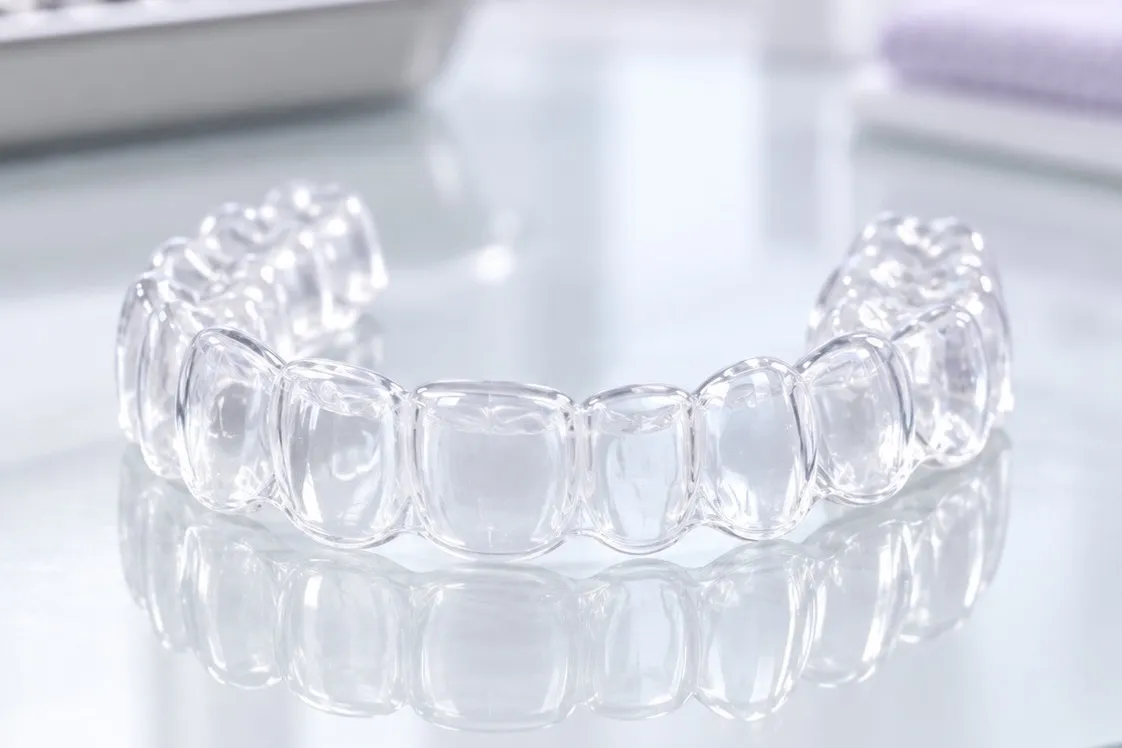
Clear aligners are trays made from your own impressions, swapped every one to two weeks. Each set moves the teeth by a fraction of a millimetre. You take them out to eat and to brush.
Fixed braces use brackets bonded to the teeth and a wire connecting them. Brackets can be metal or tooth-coloured ceramic. They stay on until treatment ends.
The real technical difference: fixed braces give better control over root movement, not just the crown. For large rotations, impacted teeth or complex bite corrections, they remain more predictable.
Clear aligners are not the “easy version” of braces. It is a technology with its own indications. A case that exceeds what it can do needs fixed braces, however much the patient would prefer otherwise.
Discipline, the part nobody mentions
Aligners only work if they are worn 20–22 hours a day. That means taking them out for meals and brushing, and nothing else. Three long coffees a day with the trays out, and the treatment stretches.
Fixed braces do not have that problem — once bonded, they work on their own. For teenagers, or for anyone who knows they are not rigorous, that is the deciding argument.
Where appearance matters
Aligners are nearly invisible in conversation. Ceramic brackets are far more discreet than metal, but visible up close.
If you work in sales, speak on stage, or are photographed often, the difference matters. If not, it weighs less than it first appears.
How the decision is actually made
At the consultation we assess with an X-ray and an impression, and only then can anyone say what is achievable. Sometimes the answer is “either works, your choice”. Sometimes it is “only one gets you the result you want”.
Do not accept a treatment plan given before that assessment — not from us, and not from anyone else.