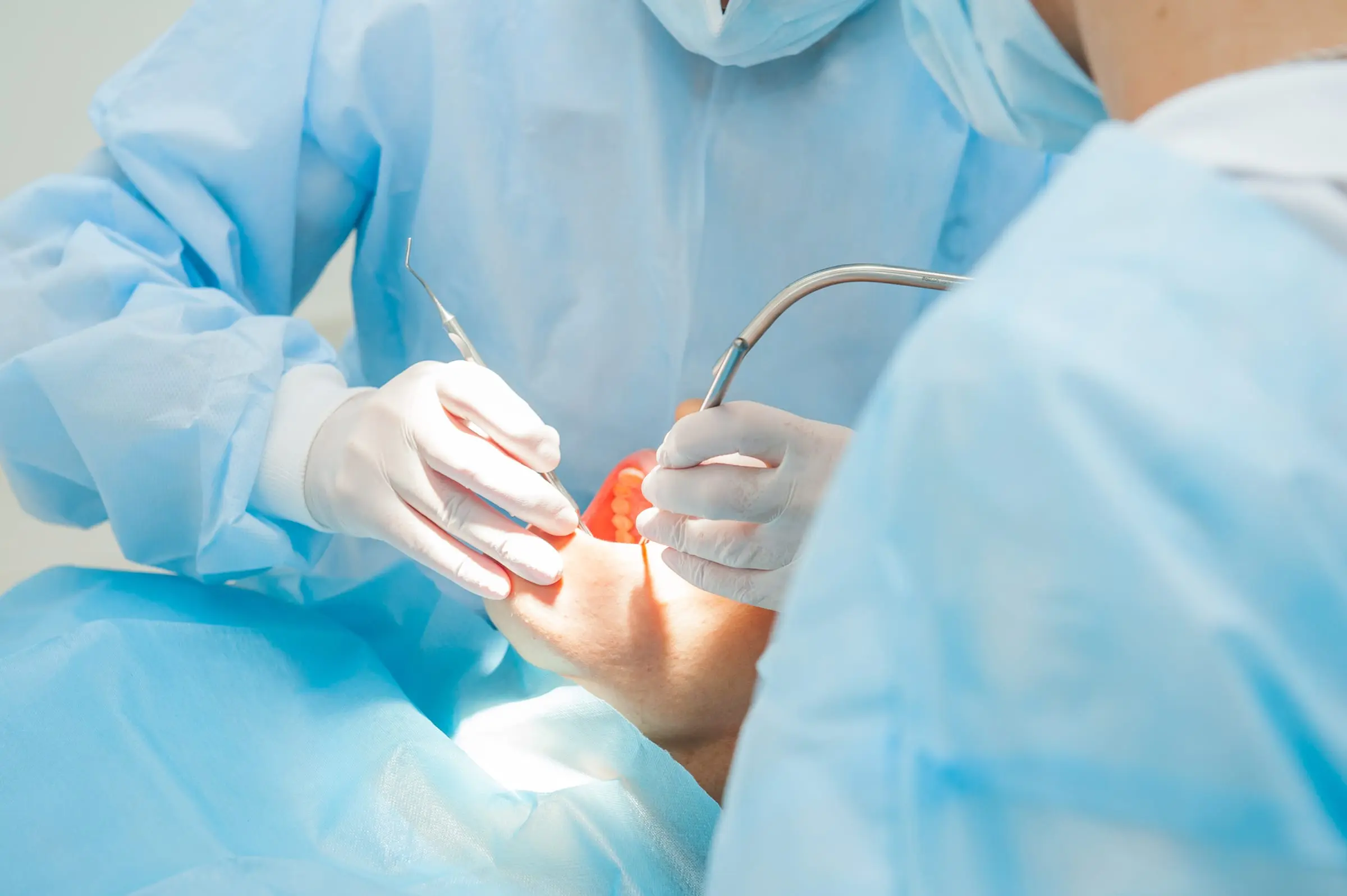
Dental surgery
Procedures done under local anaesthetic, with the recovery explained beforehand. From a simple extraction to a wisdom tooth or an apicoectomy.
- Simple extraction
- from 300 lei
- Wisdom tooth
- from 600 lei
- Anaesthetic
- local
What this covers
Dental surgery covers the procedures that work on bone and gum rather than on the tooth alone: simple extractions, wisdom tooth extractions, apicoectomy and biopsy.
These are chair-side procedures, not hospital ones. They are done under local anaesthetic, you go home the same day, and you get the aftercare instructions in writing before you leave.
A wisdom tooth can be upright, partly erupted, or fully covered by bone and gum, and the difference changes the procedure entirely. All types are treated in-house, regardless of position or depth of impaction — the clinic has oral and maxillofacial surgeons on the team.
When a tooth comes out
Extraction is the last option, not the first. A tooth with deep decay or an infection at the root tip is treated endodontically first; it comes out only when there is nothing left to save — a vertical root fracture, breakdown below the bone line, an infection that returns after retreatment.
Wisdom teeth are a different case: a tooth pushing into the one in front of it, one with no room to come up straight, or one that flares up repeatedly because the gum over it traps food.
A wisdom tooth that came up straight, cleans well and causes no trouble does not need removing as a precaution.
Apicoectomy
When an infection at the root tip does not settle after root canal treatment and retreatment, it can be reached directly: the tip of the root is exposed surgically, the infected portion is removed along with the lesion around it, and the canal is sealed at its end.
It is the procedure that saves the tooth where the alternative is extraction. It does not replace root canal treatment — it comes after it, when that alone has not resolved the problem.
Plasma from your own blood
After an extraction, plasma drawn from your own blood in the same appointment and spun on site can be placed into the empty socket, to support healing of the wound.
Because it comes from your own blood, it is not a foreign material introduced into the body. It is offered case by case, not at every extraction. It is recommended mainly for larger extractions — impacted wisdom teeth, larger sockets — and for patients with slower healing: smokers, diabetics, or those at higher risk of dry socket.
How it goes
- 01
Consultation and X-ray
day 1The position of the roots and their relationship to the sinus and the nerve become visible. This is where it is decided whether the procedure is simple or surgical, and where you learn the cost before anything starts.
- 02
The procedure
one appointmentUnder local anaesthetic. You feel pressure during it, not pain. You go home the same day.
- 03
The first few days
Swelling and discomfort are normal after a surgical extraction and ease off day by day. You get instructions on eating, keeping the area clean, and medication.
- 04
The healing check
The site is checked and, where stitches were used, they come out.
What it costs
The prices below are starting points. A surgical extraction, where the gum is lifted and bone has to be removed, costs more than a simple one — which is why the exact figure is settled after the X-ray, not over the phone.
- Simple extraction
- from 300 lei
- Wisdom tooth extraction
- from 600 lei
- Apicoectomy
- from 500 lei
- Biopsy
- from 400 lei
- Post-extraction plasma
- 250 lei / tube
Common questions
Does it hurt?
Not during the procedure, because the area is anaesthetised — you feel pressure, not pain. Once the anaesthetic wears off there is discomfort, which ordinary anti-inflammatories handle. After a simple extraction it usually lasts a day or two; after a surgical wisdom tooth, longer.
How long does healing take?
The gum closes over in about a week, and the bone rebuilds inside the socket over a few months, without you feeling any of it. Swelling after a wisdom tooth peaks in the first two or three days and then subsides — that is a normal reaction, not a sign that something went wrong.
Can I go to work the next day?
After a simple extraction, usually yes. After a surgical wisdom tooth it is sensible to keep the following day free, particularly if your work is physical. The appointment can be set before a weekend if that helps.
What if it starts bleeding at home?
Some oozing on the first day is normal. Bite firmly on a clean gauze for 20–30 minutes without changing it often, and avoid rinsing, which dislodges the clot. If heavy bleeding carries on after that, call the clinic.
What goes in its place afterwards?
It depends on the tooth. A wisdom tooth is not replaced. A tooth in the functional or visible part of the arch leaves a gap where the neighbouring teeth tilt over time and the bone recedes — that is where we discuss an implant or a bridge, and the plan is made from the start, so the extraction is done with what follows in mind.
The plan and the cost are settled at the consultation.
With an X-ray and an assessment of the bone, not over the phone. You learn the total before anything starts.